

Sony ECM-AX10: Ambisonics in the palm of your hand?
The Sony ECM-AX10 offers Ambisonics, binaural, and stereo recording, but its video-focused companion app complicates the workflow for field recording.
Introduction
I love strange devices, take note of how much I’ve professed my love of Zoom’s M4 on here, but Sony’s new ECM-AX10 may take the cake. A small microphone that plugs into a phone sounds simple enough, but the recording modes, app requirements, and export options make this one harder to explain than its size suggests. For people who primarily record sound, the biggest frustration is how many hoops we have to jump through to get the audio from a microphone.
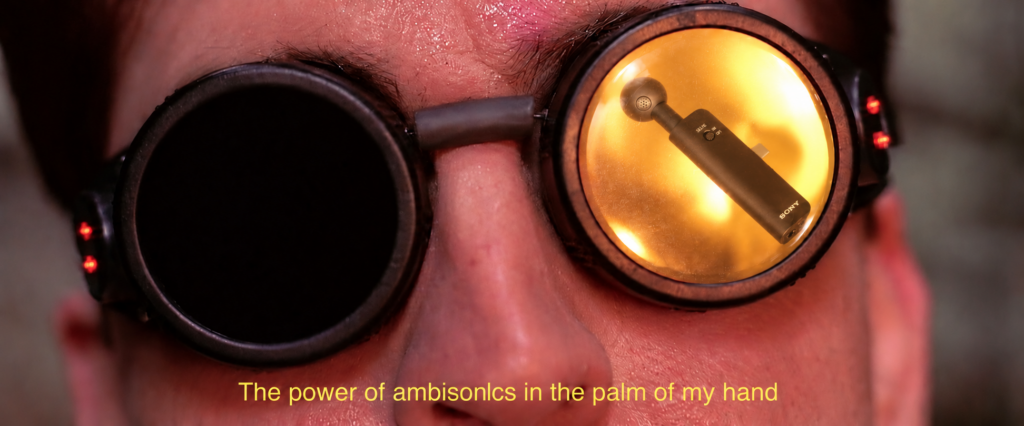
But, back to the basics, announced on October 8 with wide availability on October 23rd, the $249.99 ECM-AX10 combines four capsules with a USB-C connection and support for Ambisonics, binaural, and stereo recording. Sony introduced it alongside its Spatial Audio Video Tool app, with a clear emphasis on making videos with spatial sound. (That emphasis should have been read as more of a mandate if what you actually want to bring home is an audio recording.) Sony’s announcement
Personal Experience
I was in Japan on a personal trip, where I was wandering around taking ambisonic recordings of various harvest festivals with a Rode NT-SF1 and a Zoom H2e, so I thought it was tooooo serendipitous that such an interesting little piece dropped while I was around. I admit I picked up the mic without doing too much reading on it (and now in retrospect, there wasn’t a whole lot of information put out there on it.)
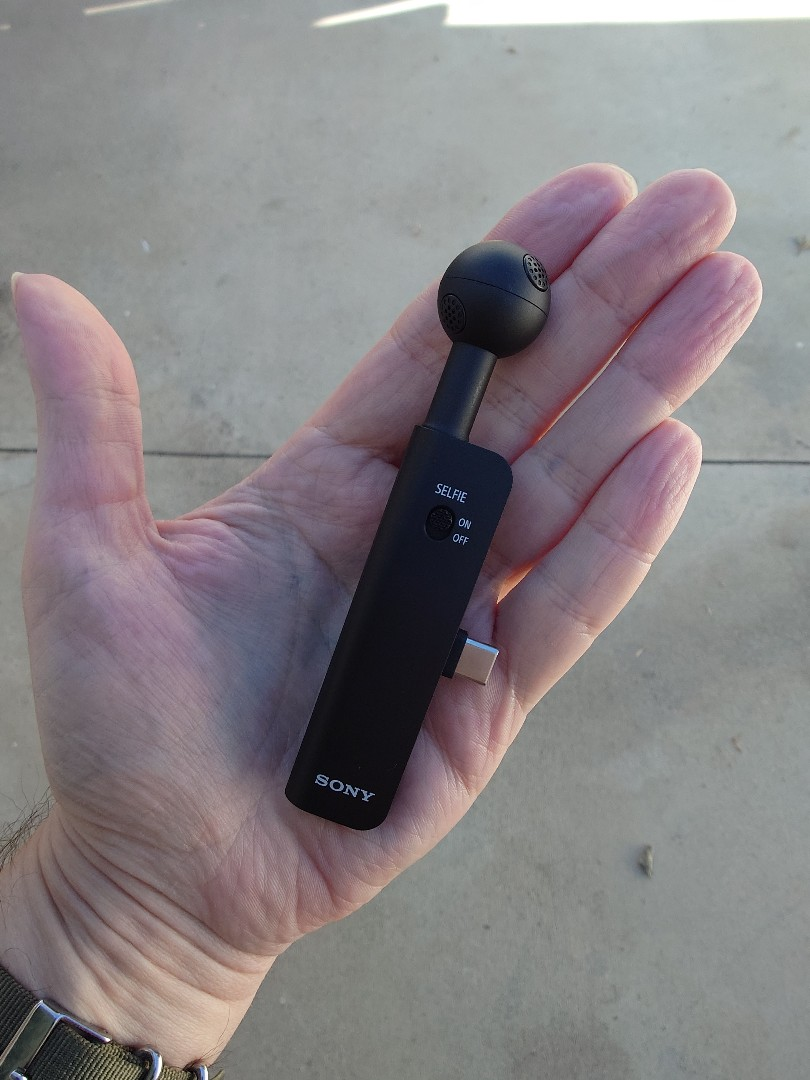
So first impressions, it’s well built, the switches feel nice, the USB C connector is good and gives some mechanical confidence. The blue grey plastic evokes the Playstation 2 era and all handling the memory cards. Maybe that’s where the device really feels like it comes from. The configuration for it is all done with switches, between selecting the front vs rear facing angle (they call it ‘selfie’), choosing between spatial/stereo, attenuation, or filter seems like switches taken straight off the Walkman production line.
Software or menu control should be trivial in this modern USB era, for a device that requires a host to function, but the switches still help the experience feel tactile.
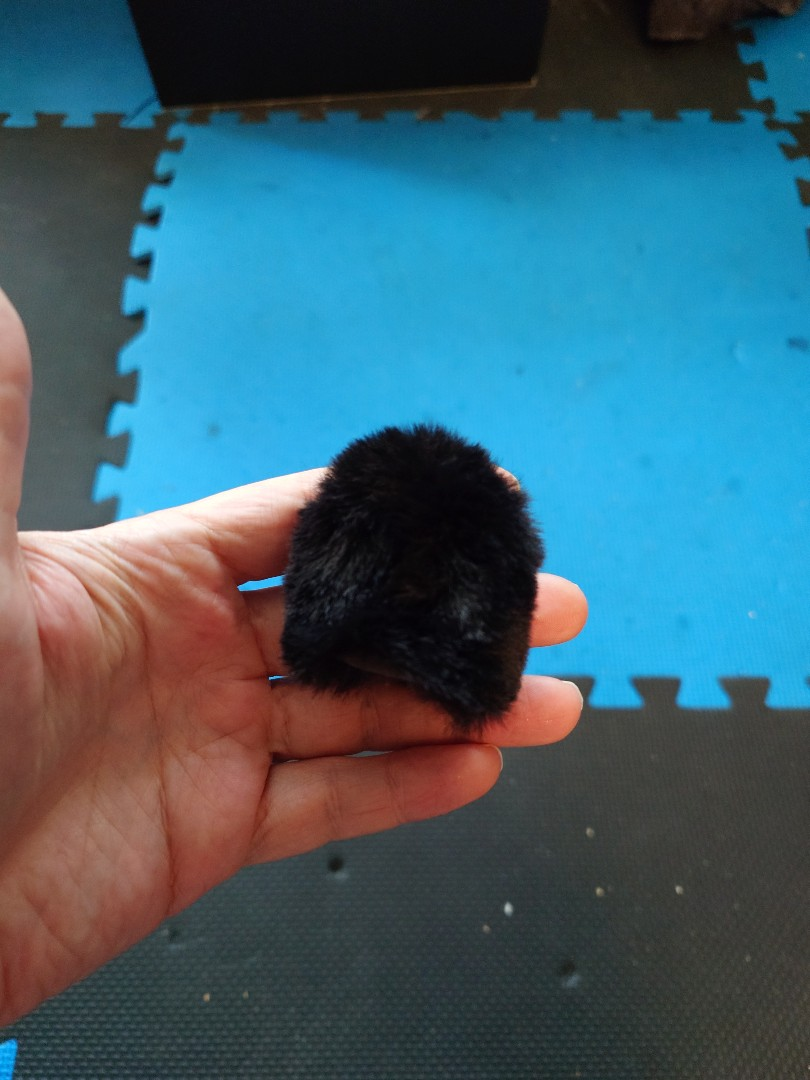
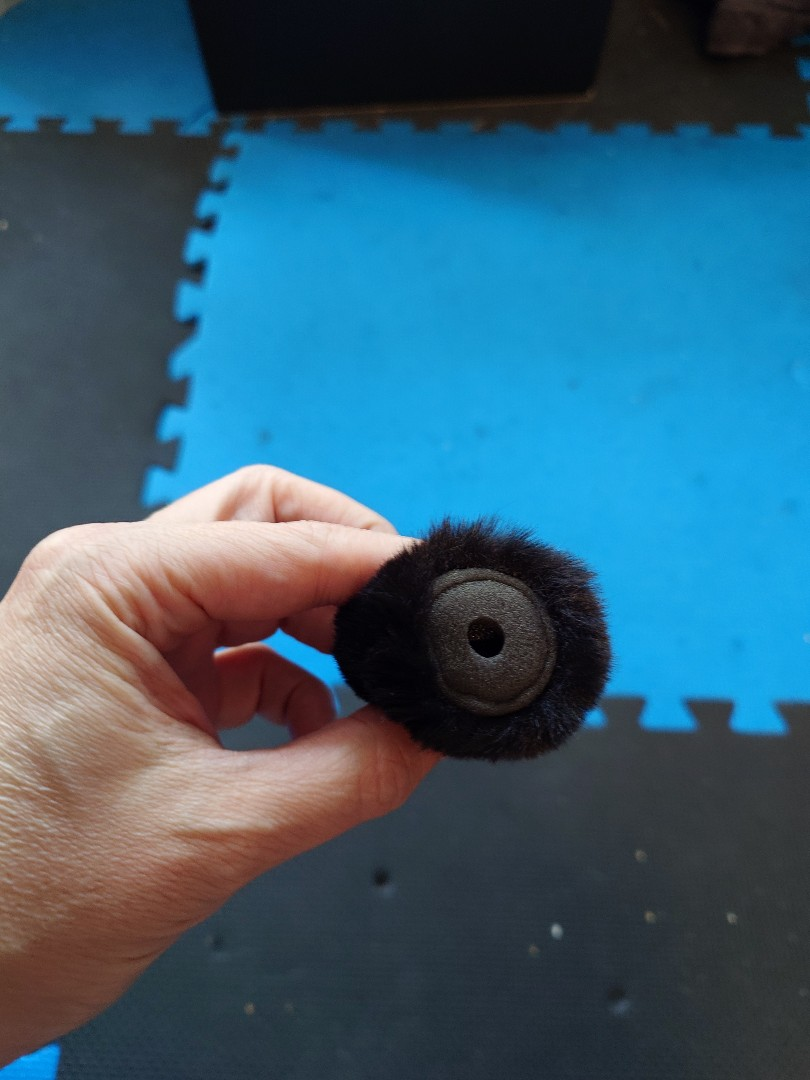
The accessories are nice, the cold shoe clamp is an especially nice touch, bespoke clearly for the curves of the AX10, which isn’t really expected anymore. The wind protection fluffy leaves a little bit to be desired (the foam thickness varies, and the fur only covers the sides and top) so it’s not really suited for recording in any form of weather other than sunny, but maybe one day one of the other vendors will make something that fits
There are…reasons…why it’s not easy to get a noise floor or other ‘normal’ field recording measurements out of the mic, but I’m going to work on those too, but more on the reasons in later sections (hint: we don’t get raw capsule audio.)
Regardless of lack of measurements, it sounds pretty good. I’ve only been playing with it, but I am going to get some direct comparison recordings between it and the NT-SF1 for comparisons in a future post.
Specifications from Sony
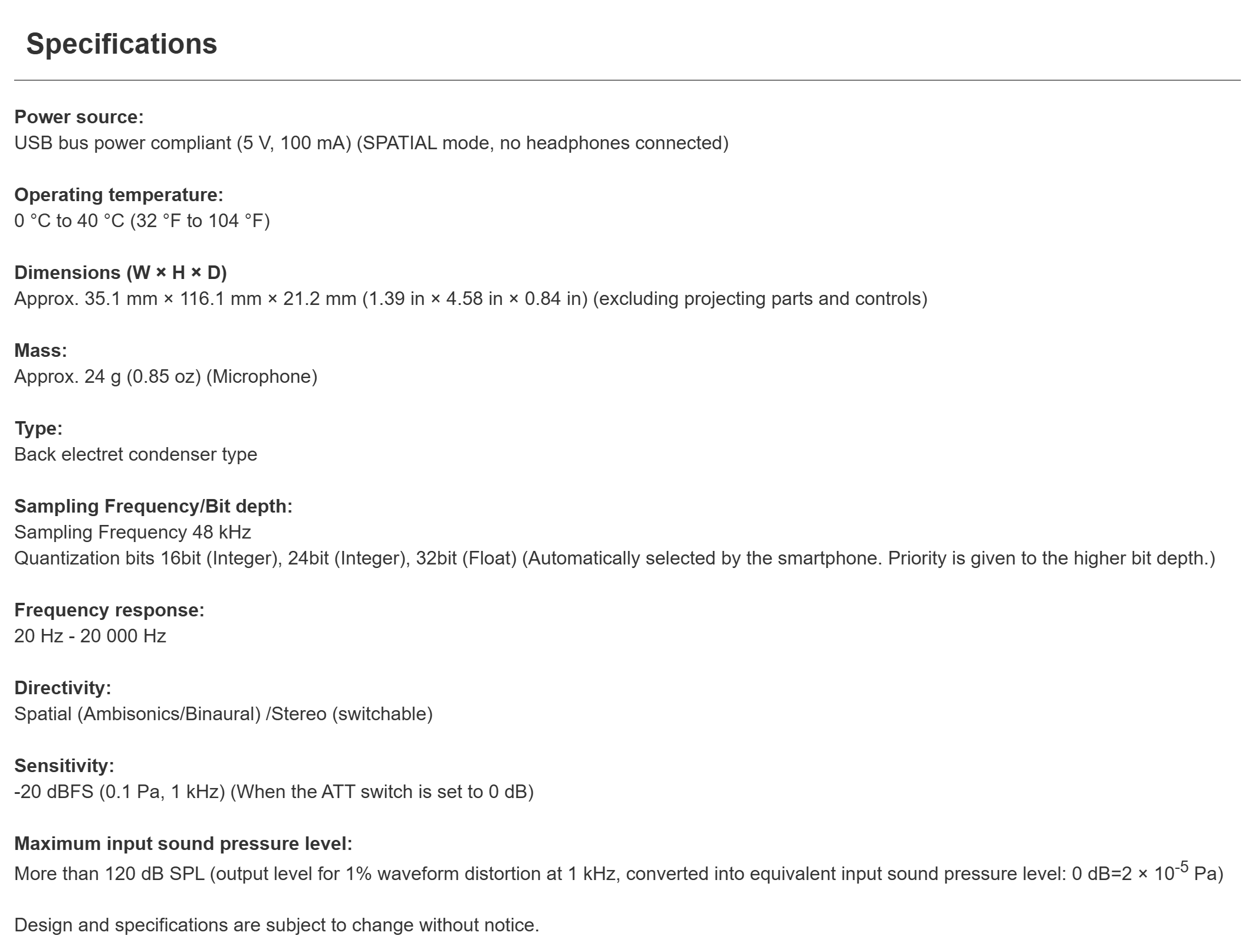
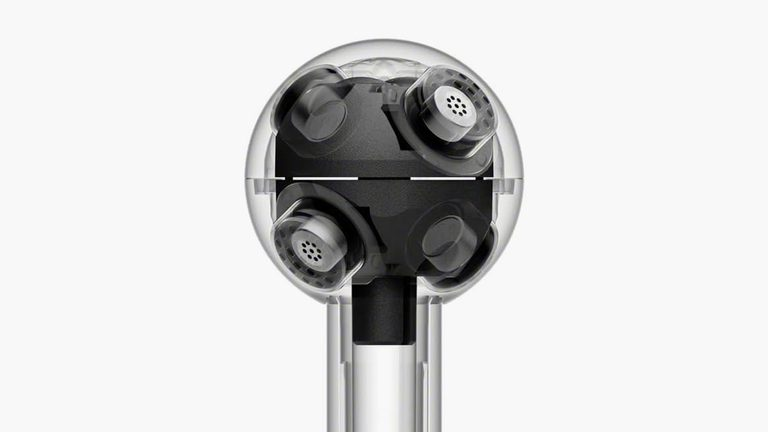
The specifications are nice enough, and the tetrahedral arrangement is something anyone who’s played with any of the other common ambisonic mics (Rode’s NT-SF1, Zoom’s H3-VR, Sennheiser’s Ambeo, etc) should be used to.
The app adds another dependency. Sony says that using the microphone with other recording apps supports stereo or binaural recording; switching the microphone to SPATIAL in those apps produces binaural audio. The dedicated Sony app is the only documented route to its four-channel Ambisonics workflow. Sony’s other-app guidance
So here the complications start: the switch position does not really tell you entirely what’s going on…
Spatial Audio Video Tool puts video first
The companion software’s name is a case of truth in advertising. Sony’s recording instructions describe shooting a video, and its audio export instructions start with selecting a recorded video. You can then export the Ambisonics audio as a four-channel AmbiX WAV file. Sony does not document a separate audio-only capture mode in that workflow. Recording guide, export guide
For field recording, that is awkward. I want to pull the phone out of my pocket, hit record, save the data, and ideally be able to dump it into FurtherAfield or some other playback app right away. A workflow that starts with video and ends with FFMPEG to get to the audio adds a step that has nothing to do with the recording I wanted in the first place.
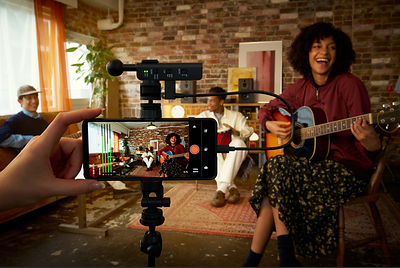
The editing tools are limited as well. Sony’s FAQ says the app edits recordings made within the app; it cannot edit footage imported from other apps. Combine videos with different audio formats in one project, and the export is restricted to stereo. Basic trimming and combining are useful, but this is a narrow production environment for a microphone with several recording formats. Sony’s app FAQ
It essentially means that anything you want to do is going to have to go through Resolve or some other ‘big’ editor.
A standard interface, and a simpler recorder
Fortunately, Sony did something here that is distinctly un-Sony: the AX10 exposes its four-channel audio through USB Audio Class 2.0 (UAC2), a standardized interface. On my Xperia phone (yes, go ahead, call me a fanboy,) I could start that stream using standard USB audio controls. I didn’t need Sony’s video app or a proprietary Sony library to get the ambisonic audio out of the microphone.
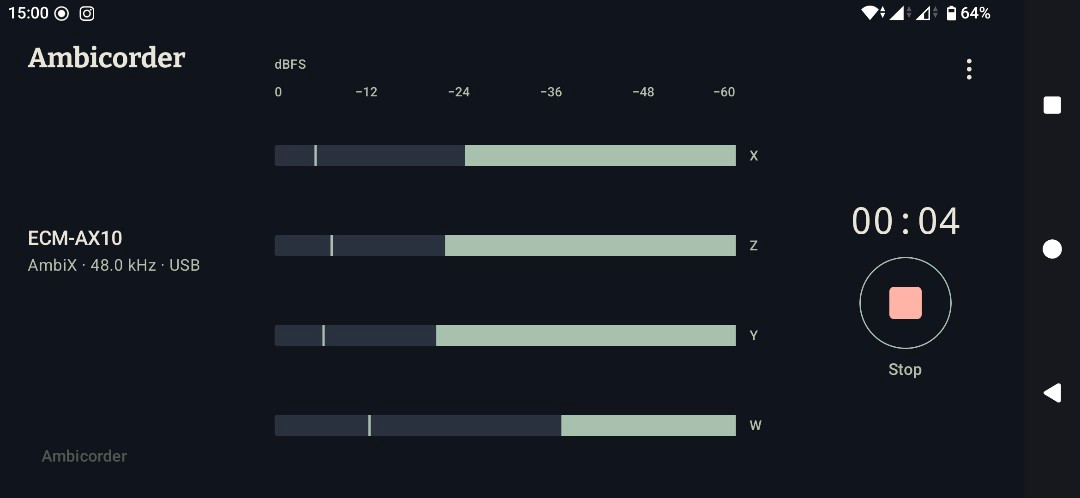
That gave me a way to fix the huge, glaring frustration. So, over the weekend I whipped up Ambicorder, a small Android recorder with a simple job: connect to the AX10, show the four channel meters, and record a WAV. Tap Record, tap Stop, and the file gets saved in the chosen recording folder. No video to shoot and no audio to extract afterward. Behaves just like any other handy recorder I have.
The AX10 has some kind of DSP or processor on board (as shown by how warm it gets…) and it does not give pure mic recordings over the USB bus. In Spatial mode it is already giving B-Format AmbiX tracks, and on Stereo it must be feeding through some other model (and binaural likely a HRTF to present its decently convincing binaural, do not ask me for an ASMR test).
So having found this, Ambicorder captures four channels directly over USB at the 48 kHz maximum in 32-bit float. It preserves the incoming audio samples and adds AmbiX metadata for the AX10, so FurtherAfield or any other compatible player/DAW can immediately recognize the recording without making me map tracks.
Just because it’s UAC2 doesn’t mean every recording app will automatically expose all four channels. In fact most won’t…hence Sony’s flag in their press release. I had to open the USB audio stream directly, using libusb, rather than relying on the phone’s usual audio input route. Sony’s choice to use a standard interface is what made that approach possible, but it’s still not immediately compatible.
I’d still like Sony to put an audio-only recording mode in its own app. In the meantime, credit where it’s due: using a standard gave room to make the recorder I wanted. The AX10 is a more appealing little device when I can plug it in and just press Record. Whether I get enough people interested in this to put it in the store, is a different story, but if you’d like it feel free to drop me an email and I’ll happily send you the APK. If there’s interest in an iPhone version that should be possible too, I just don’t have a USB C iPhone to test with.
Edit: I uploaded the recorder app to the Google Play Store, and opened it up to beta testers. Unfortunately I can’t just list it for anyone to download yet (I need 12 users for 14 days for that) but if you would like to download the app, all you have to do is join this Google Group with the same email you use on the Play Store, and then click here to go to the store listing. If you don’t join the group, it will just show as an error. Either way, if you wind up using the app, shoot me an email or send a message in the group, I’d love to get more thoughts on how best to make this rather than my own engineer’s eyes.
Why this microphone, and why now? A little speculation
The AX10 sits at a strange crossroads. Sony made some legendary handheld recorders, and sadly, it seems that part of the company has had all its food gobbled up by the on-camera microphone business. The PCM-D100 is officially discontinued (as well as the D50, A10, and M10), while products like the ECM-W3 and ECM-S1 make the emphasis on video creators pretty clear. Sony still lists portable recorders in some markets, so this isn’t a claim that it has abandoned the category entirely. But it does leave me wondering where field recordists fit into its plans.
Sony’s stated pitch is spatial audio for vloggers and mobile filmmakers, including Eclipsa Audio export for YouTube. But Eclipsa still feels to me like a solution in search of a problem. If getting filmmakers to adopt it is the rationale, why is the companion app limited to 1080p at 30fps at launch? Sony says 4K support is planned from December 2026 onward, but that doesn’t fix the proposition today: adopt a new audio workflow while accepting fewer video options. That makes the launch feel unfinished, and leaves me wondering whether the hardware has possibilities beyond the use Sony is selling.
Which brings me back to 360VME. I was lucky enough to have a demo at Sony Pictures Studios, and the pitch that stuck with me wasn’t just hearing their demonstration room through headphones. It was being able to capture your own studio and take that familiar monitoring environment home. Sony describes 360VME as a way to take a measured studio environment with you, and offers measurement in your own studio as well as at partner facilities. This account of a Sony 360 Reality Audio demonstration gives some context for the speaker-to-headphone experience, though it doesn’t establish any connection to the AX10. Guess who did a lot of the work on the 360VME? The same Sony PCL subsidiary that the press release so happily features.
Here’s my speculation: could the AX10 be a sneaky way to get a spatial measurement tool into the market? Something akin to an RTA or room-measurement mic, capturing the speaker-and-room side of a future studio-recreation workflow. A small array connected to a phone seems like an interesting way to simplify some of the clunky setup I remember them wanting to iron out.
The economics are the other half of the speculation. I would expect the market for a dedicated 360VME measurement accessory to be tiny beside the market for phone and camera accessories. I don’t have sales figures, but it’s hard to imagine that niche alone supporting the volume a multi-national Goliath like Sony would want for a consumer electronics product. If a measurement role were part of the plan, Sony would have a reason to look elsewhere for enough buyers to justify making the hardware. Selling it to video creators could provide that broader market, while the same array eventually serves a much smaller studio audience. Essentially building a small device for one use, and gambling they uncover a new market. It worked with the DSD and FLAC playback in the D100…
Coming back down to earth, my conclusions
I like the AX10. I like how small it is, I like that I can always have it in a pocket for recordings. I like that it sounds nice.
What I don’t like. The software limitations. THE SOFTWARE LIMITATIONS. Okay, I get that you’re promising a post launch update in ‘December’ but how do we live in a world now where a new hardware device can be launched faster than software. I wrote an audio recorder for it in one manic weekend…
I don’t like the wind protection, and if I were really nitpicky, I don’t like that the USB plug is a permanent right angle. I would have much rather had either a female usb on the device that needed a cable, because right now if it breaks, well, throw it out.
That’s the other thing that’s not great. You pay the Sony tax. I was prepared for this, but ultimately, I think this is where it falls out for most field recordists. Especially since this does really feel much more like a device from the late ‘aughts.
If your goal is to record some spatial audio with an inexpensive but feature rich pocket sized recorder, well the H2essential is the better choice. Yes, it’s only double mid side, so you lose the elevation part of the spatial effect, but that’s the trade off for a much more modern device.
Keep your eyes open for a follow up post with some examples, and if I can, hopefully a video.