The vocabulary around environmental audio can be surprisingly broad. I’ve briefly discussed the take/recording dilemma before, and today I’d like to touch on field recording, ambience, and soundscape. These terms are often used interchangeably in casual conversation (well, mostly reddit and youtube, normal people don’t really use them at all,) yet each carries a distinct history, lineage, and theoretical set of expectations.
Field Recording
Field recording is the simplest of the three terms, because it describes a practice: going out into the world and capturing sound with a microphone and a recorder. It doesn’t imply how the audio will be used, what type of audio, who will listen to it, or what it “means.” It just tells you how it was made.
Historically, field recording shows up in a few different places at once. Archivists and researchers were using cylinders and tape machines to document music, speech, and wildlife as far back as the early 20th century. Ornithologists were busy figuring out how to capture birds without scaring them away. And by the mid-century tape era, portable machines made it much easier to record species, environments, and culture outside the studio.
The legendary David Attenborough released a CD set in 2018 titled My Field Recordings From Across The Planet which showcased field recordings from his many adventures he took on his “clumsy tape recorder” between between 1954 and 1963.
As the equipment became smaller and less clumsy, field recording eventually found a wider audience with sound art and sound design. Creature designers, Foley artists, and experimental musicians could go out and collect from a much wider variety of objects or creatures without having to worry about acquiring them, let alone getting them through the studio door.
Today the field recording community is spread across wildlife research, sound design, YouTube, game audio, boutique SFX libraries, musicians capturing samples, and hobbyist recordists who simply like the excuse to go outside. A modern field recording might be a clean capture of a bird species for scientific analysis (or adding to a machine learning dataset), a multi-channel ambience for a VR environment, a textural layer for a video game, or maybe even someone drumming on a sand dune to be used as an effect to call a giant worm in a movie.
Field recording doesn’t tell you how a sound is meant to be consumed, it is just the practice of treating the world as your studio.
Ambient / Ambience / Atmospheric Sound
Ambience (or ambient audio) is a little trickier to define, because unlike field recording it doesn’t describe how the sound was captured. Instead, it’s mostly about how the sound is used. Ambient audio is typically meant to sit in the background supporting something else rather than being the focus.
The modern idea of ambient music is widely attributed to Brian Eno, and especially his 1978 album Ambient 1: Music for Airports (which if you haven’t listened to it I highly recommend.) Eno described ambient music as something that could function at multiple levels of attention: interesting when listened to closely, but harmless when ignored. It wasn’t meant to tell a story so much as to create a vibe.
Meanwhile, film and television sound departments were already using terms like room tone, backgrounds, and ambience to describe the environmental layers that support the believability behind dialogue and action. In that lineage, ambience is functional: it gives a scene a passive sense of place or tension without getting in the way of the plot.
Those two lineages, ambient music and production ambience, eventually converged online. On YouTube and streaming platforms, ambience often means “audio (and sometimes video) to work, study, relax, or sleep to,” ranging from airport lounges to cyberpunk rainstorms to fantasy taverns full of politely murmuring elves. The common thread is that ambience is a utility: it exists to make another activity nicer.
The rise of second- and third-screen content shows the value of this in an ever accelerating world. Unlike field recording, ambience doesn’t tell you where a sound came from or how it was captured. It just focuses on how the sound is meant to be consumed. The fact that YouTube now contains thousands of 10-hour ambience loops reveals the term’s utility potential, and also the existence of very patient servers.
Soundscape
Lastly, soundscape is different from the other two terms because it describes how a sound environment is perceived, rather than how it was made or how it is used. The word was popularized in the 1960s and 70s by composer and researcher R. Murray Schafer and the World Soundscape Project. His interest was in how the acoustic character of a place affects the people who inhabit it.
In that framing, a soundscape is not just an audio recording of a place. It is the experience of being in that specific place at that specific time. Schafer introduced concepts such as keynotes, signals, and soundmarks (the sonic equivalent of a landmark) to describe how people notice and prioritize sound in their environment.
Soundscape is also the only one of these three terms with a formal modern definition. The ISO 12913 soundscape standard describes it as “the acoustic environment as perceived or experienced by a person or people, in context.” In other words, soundscape is about experience just as much as sound.
This formalization puts it into a similar active framing as well, a soundscape can be curated similarly to a landscape, and is one of the key unseen tenets in themed entertainment design like the Disney Parks or interactive museums. Over time the term migrated into more conventional urban design and planning. Cities began to be understood not only in terms of noise levels but also in terms of acoustic experience.
Later, spatial audio, VR, streaming, and slow media revived the word again. Microphones and cameras are now placed in real environments and the viewer is invited to settle into them for a while. As I write this at 11:30 am on a Tuesday there are no less than 6 currently live channels streaming from various parts of Disneyland.
On YouTube, a soundscape might be a locked-off camera at a temple, a train station, or a forest clearing paired with carefully recorded audio. The emphasis is less on background utility and more on place- and time-based experience, even if that experience is happening through a browser tab in the background of a smartphone screen as someone falls asleep.
Unlike field recording, soundscape describes what the sound feels like rather than how it was captured. And unlike ambience, it does not primarily exist to support another task. A soundscape can reward active attention, drift into passive listening, or simply remind you that the world is full of sonic texture when we are active listeners.
If field recording is the action and ambience is vibe, soundscape is experience.
Why Three Words for Nearly the Same Thing?
If all three terms point to roughly the same cluster of activities, why do they sort into different corners of the internet and popular culture? This turns out to be less about theory and more about incentives. Platforms and communities reward different framings of the same material.
YouTube, and the internet at large, tends to favor “ambience” because ambience aligns with how people use YouTube in the background while doing something else. The vocabulary reflects the task. “Study with me,” “sleep sounds,” and “rain for focus” are not describing the methodology of the audio. They are describing the job the audio is meant to do. When people search YouTube, they are not looking for capsules, recorders, or mic patterns. They are looking for a mood and a duration. See how much of a cultural force “lo-fi beats to study to” have become.
Reddit and similar forums (facebook included) skew toward “field recording” thanks to its technical nature. Especially for gear. The internet loves gear and all the discussion around it. I am just as much guilty here, I have to keep reminding myself to actually get out and use my tools. To drive this home even more, /r/fieldrecording has ~32,000 subscribers, while the largest subreddits for the other words and their permutations are all below 1000 subscribers.
“Soundscape” surfaces heavily in academic, design, and planning contexts because it is the only term with a formal definition. ISO standardization gave it legitimacy in fields that have to describe environments in a serious way. Architects, urbanists, and researchers need a term that points to perception and measurement. “Ambience” is too casual for that and “field recording” points to the wrong part of the workflow. Of the three soundscape, from my brief searches, is the most likely to be listed in a job posting.
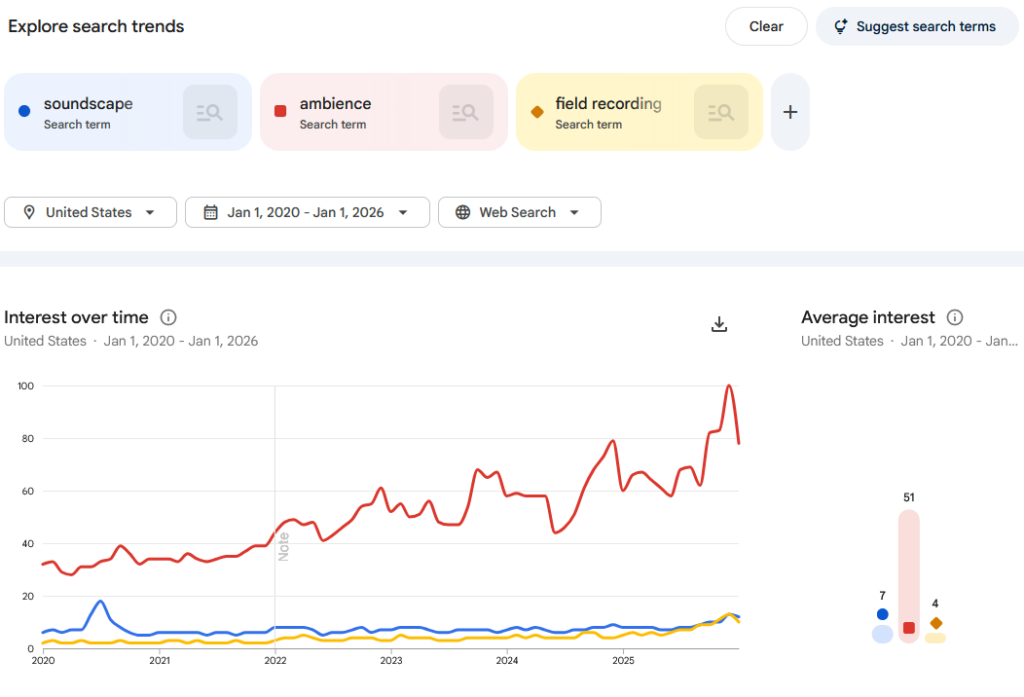
Of all those groups, Google Trends shows that ambience has the largest number of searches by far:
This struggle with the vocabulary is something that I’ve fought a lot with internally. I started taking long form recordings because I was privileged to be in really interested places and wanted to be able to remember what they were like, and even better I could work as my desk job with them up on my second monitor. So, sure, I go out and I take these as a field recording because I’m out in the world, they are meant to be enjoyed as ambient background while I am both in that place and not, and they are soundscapes because they are a straightforward capture of a place without extra things added on top.
So, what do I call these things when I want to share them?